
CAATEX acoustic experiment, contributor to HiAOOS, featured by SciLight
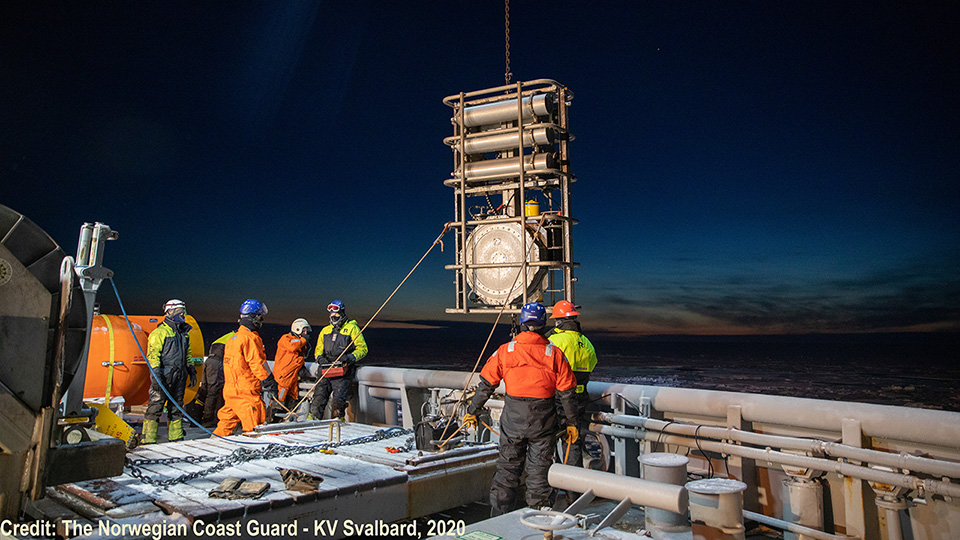
Research contributing to HiAOOS has recently gained international visibility through a feature article published by SciLight, the science news service of AIP Publishing. The SciLight article highlights new findings from the Coordinated Arctic Acoustic Thermometry Experiment (CAATEX), a project whose data are shared with and support the objectives of HiAOOS.
In the SciLight story, “Listening to the changing Arctic Ocean” published 2 February 2026), science writer Chris Patrick reports on results from a year-long acoustic experiment conducted between 2019 and 2020 across the Arctic Ocean. CAATEX deployed six bottom-anchored moorings, of which two carried sources that transmitted low frequency signals every 3 days. The signals were received at all the other moorings at distances up to 2,600 kilometres. Acoustic thermometry enabled continuous observations of the ocean beneath sea ice where conventional measurements are extremely limited.
The featured research shows that acoustic signals were detected at higher frequencies than in similar trans-Arctic experiments carried out in the 1990s, potentially reflecting changes in ice thickness and structure. The measurements also revealed strong seasonal variability in acoustic travel times, providing rare insight into large-scale Arctic Ocean variability on sub-annual timescales.
“Our work advances the use of acoustics to study the Arctic Ocean,” said Hanne Sagen, NERSC, coordinator of HiAOOS and a co-author of the study. “The results show that long-range acoustic measurements can be made reliably across the Arctic to provide continuous, year-round observations in one of the hardest regions on Earth to monitor.”
The SciLight article is based on the peer-reviewed paper:
Dzieciuch, M. A., Sagen, H., Worcester, P. F., Storheim, E., Akins, F. H., Sandven, S., Colosi, J. A., Kemp, J. N., and Leinebø, G. M. (2026). “Transarctic acoustic transmissions during the coordinated Arctic acoustic thermometry experiment in 2019–2020,” Journal of the Acoustical Society of America.
https://doi.org/10.1121/10.0042233
“Further, the acoustic travel times were found to vary significantly over the year,” added author Matthew Dzieciuch, Scripps.
While CAATEX is a standalone US–Norwegian research initiative, its acoustic data are shared with HiAOOS, contributing to the integration of diverse Arctic observing systems and strengthening access to sustained, basin-scale ocean observations. This collaboration exemplifies how targeted research experiments can feed into long-term observing infrastructures such as HiAOOS, enhancing Arctic monitoring capacity and climate understanding.
HiAOOS warmly acknowledges SciLight and AIP Publishing for showcasing this work and helping bring Arctic acoustic research—and its relevance to sustained observing systems—to a broader scientific audience.
You can check out the full issue of SciLight here: