
Using Sound to Track Rapid Arctic Change: Insights from the DOSITS Webinar
On April 29, the Discovery of Sound in the Sea (DOSITS) 2026 webinar series spotlighted how sound is revolutionizing the way scientists observe the rapidly changing Arctic Ocean. The event, titled “Observing the Changing Arctic Ocean with Acoustics,” featured HiAOOS’ Coordinator Dr. Hanne Sagen, Research Director at the Nansen Environmental and Remote Sensing Center (NERSC), and Dr. Peter F. Worcester, Research Oceanographer Emeritus at the Scripps Institution of Oceanography. You can find out more about these experts here.
Together, the two experts offered a deep dive into how underwater acoustics can provide unique insight into temperature, circulation, and climate-driven transformation beneath the Arctic ice.
The Need for New Ways to see Beneath the Ice
The Arctic is warming up to four times faster than the global average. According to Dr. Sagen, air temperatures and shrinking sea ice are clear indicators of this trend: since satellite monitoring began in 1979, September sea ice extent has declined by about 13% per decade, and the average Arctic temperature has risen more than 3°C.
“Some regions, like the Barents Sea, are warming up to ten times faster than the global mean,” Hanne explained.
Traditionally, ocean measurements rely on point-based instruments such as moorings or profiling floats, but these are difficult and expensive to operate under sea ice. Acoustics, by contrast, can measure conditions over thousands of kilometers, using sound to calculate changes in ocean temperature, salinity, and current structure.
Listening to the Arctic: The Power of Acoustic Thermometry
Dr. Worcester outlined how acoustic thermometry works: by transmitting low-frequency sound pulses through the water and precisely measuring how long they take to travel between instruments, scientists can determine the ocean’s average temperature along that path.
“Light doesn’t travel far in seawater, but sound can travel for thousands of kilometers—even under ice,” said Peter.
The researchers showcased results from the landmark CAATEX experiment (Coordinated Arctic Acoustic Thermometry Experiment), the first year-round, basin-scale acoustic study across the central Arctic. Conducted between 2019 and 2020, the project used a network of moored sound sources and receivers stretching over 2,500 kilometers from Svalbard to north of Alaska.
CAATEX data revealed significant variations in ocean temperature layers and demonstrated that acoustic signals could reliably monitor change across seasons and vast distances, even through thick ice cover.
Towards a Sustained Arctic Acoustic Network
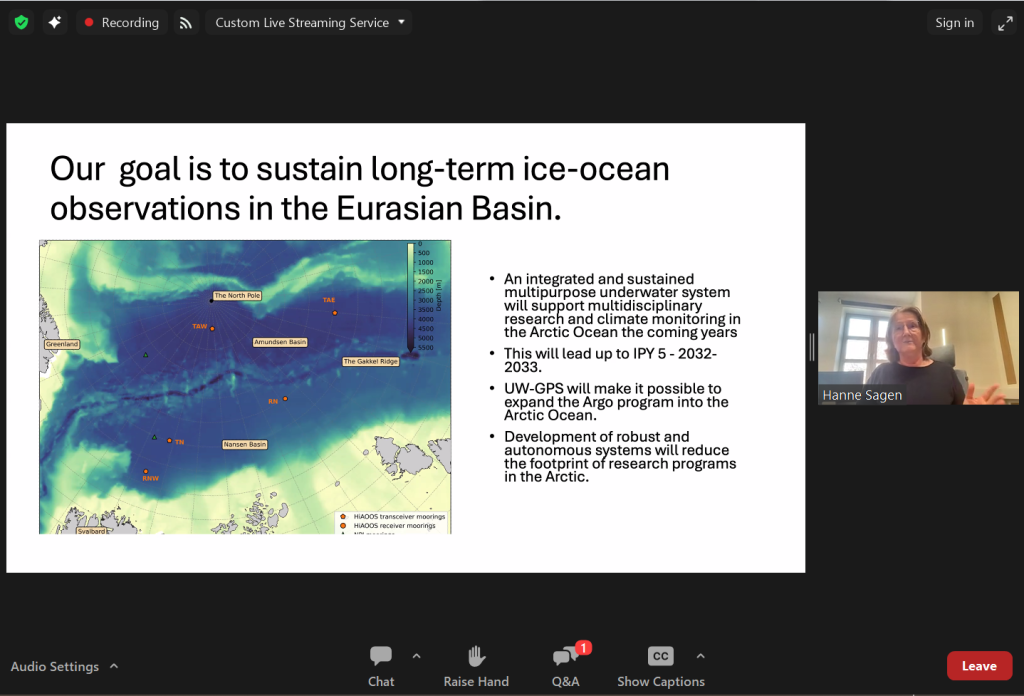
The webinar also introduced our project, HiAOOS (High Arctic Ocean Observing System), Hanne described how it builds on the CAATEX legacy: “We are developing multipurpose acoustic moorings that not only measure ocean temperatures but also help position autonomous underwater vehicles (AUVs) and profiling floats beneath the ice, creating what we call an ‘underwater GPS system.’”
By testing and validating acoustic positioning against satellite-based GPS, researchers aim to support wider use of Argo floats and AUVs in the Arctic, where current data coverage is limited. HiAOOS field deployments began in 2024, with system recovery scheduled for summer 2026 to analyze the first year’s data.
Minimizing Environmental Impacts
In response to audience questions, both speakers emphasized that minimizing impacts on marine life is integral to the research design. The acoustic signals used are very low in intensity and have an extremely low duty cycle—roughly 15 minutes of transmission every three days.
“They (the signals) are not like a loud sharp pulse.,” Peter explained. “They are very much like white noise. Marine life wouldn’t even know they were there.” Environmental assessments were carried out for all deployments, and signals include gradual “ramp-up” sequences to allow animals nearby to move away before full intensity is reached.
International Collaboration for a Changing Ocean
The CAATEX and HiAOOS efforts unite multiple institutions, including the Nansen Environmental and Remote Sensing Center, Scripps Institution of Oceanography, the Norwegian and U.S. Coast Guards, and the Research Council of Norway.
“This kind of work isn’t done by one or two people,” said Hanne. “It takes engineers, scientists, students, ships, and international coordination to make it happen in one of the most challenging environments on Earth.”
Peter added that maintaining such systems in place over time is vital: “The Arctic is changing faster than anywhere else on the planet. What happens there affects the world’s oceans and climate.”
Next Steps in the DOSITS 2026 Series
This session was the second in the 2026 DOSITS webinar series. Future webinars include “Distributed Acoustic Sensing for Ocean Acoustics” with Dr. Shima Abadi (University of Washington) on September 23, 2026, and “Acoustic Sensing on Autonomous Underwater Platforms” on October 14, 2026.
Participants who complete all four sessions and accompanying questionnaires are eligible for a Professional Development Certificate from DOSITS.
For more information and access to the recorded presentation, visit the Discovery of Sound in the Sea webinar archive.