
HiAOOS Partner IOPAN Brings Long-Term Arctic Observations to ASOF 2026
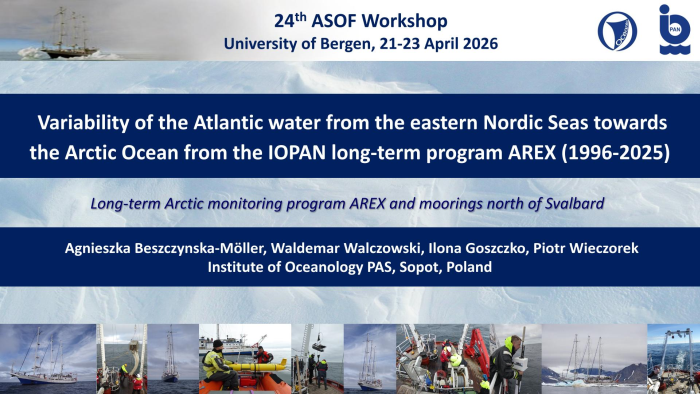
At the 24th Arctic–Subarctic Ocean Fluxes (ASOF) workshop in Bergen, HiAOOS partner the Institute of Oceanology of the Polish Academy of Sciences (IOPAN) shared insights from almost 30 years of observations of Atlantic water moving through the Nordic Seas towards the Arctic Ocean.
Held from 21–23 April 2026, ASOF brought together the international research community working to understand exchanges between the Arctic and Subarctic oceans. IOPAN’s Agnieszka Beszczynska-Möller presented research on the “Variability of the Atlantic water from the eastern Nordic Seas towards the Arctic Ocean from the IOPAN long-term program AREX (1997–2025) and moorings north of Svalbard (2012–2024)”, drawing on observations from the institute’s long-running AREX programme from 1997–2025 and mooring measurements north of Svalbard from 2012–2024.
Following Atlantic Water into the Arctic
Atlantic water carries heat northwards through the Nordic Seas, with branches continuing towards the Barents Sea and through the Fram Strait into the Arctic Ocean. Changes in the temperature, circulation, and other properties of this water are therefore an important part of understanding changes taking place in the European Arctic.
Maintaining observations over many years is particularly valuable. Individual expeditions provide detailed snapshots of ocean conditions, while long-term programmes and sustained mooring observations allow scientists to investigate how those conditions vary from year to year and over decades.
Turning HiAOOS observations into knowledge
Within HiAOOS, IOPAN leads the work on “Methods and Tools”, which develops methods to analyse and visualise the observations generated by the growing Arctic observing system. The work covers physical oceanography and sea ice as well as acoustic applications, including acoustic thermometry, underwater positioning and the validation of ocean models. This work also brings together time series from HiAOOS moorings with observations from earlier Arctic projects and allows complementary atmospheric, sea-ice and remote-sensing data to be incorporated. It is also developing tools to generate ocean and sea-ice statistics and to compare observations with ocean–ice reanalyses and other gridded datasets.
By combining IOPAN’s long-term knowledge of Atlantic-Arctic processes with new observations from HiAOOS, researchers can place the project’s data within a much longer record of change in the European Arctic.
*Cover image by Annie Spratt on Unsplash