A Unique Under-Ice Mooring Network Recovered After Two Years
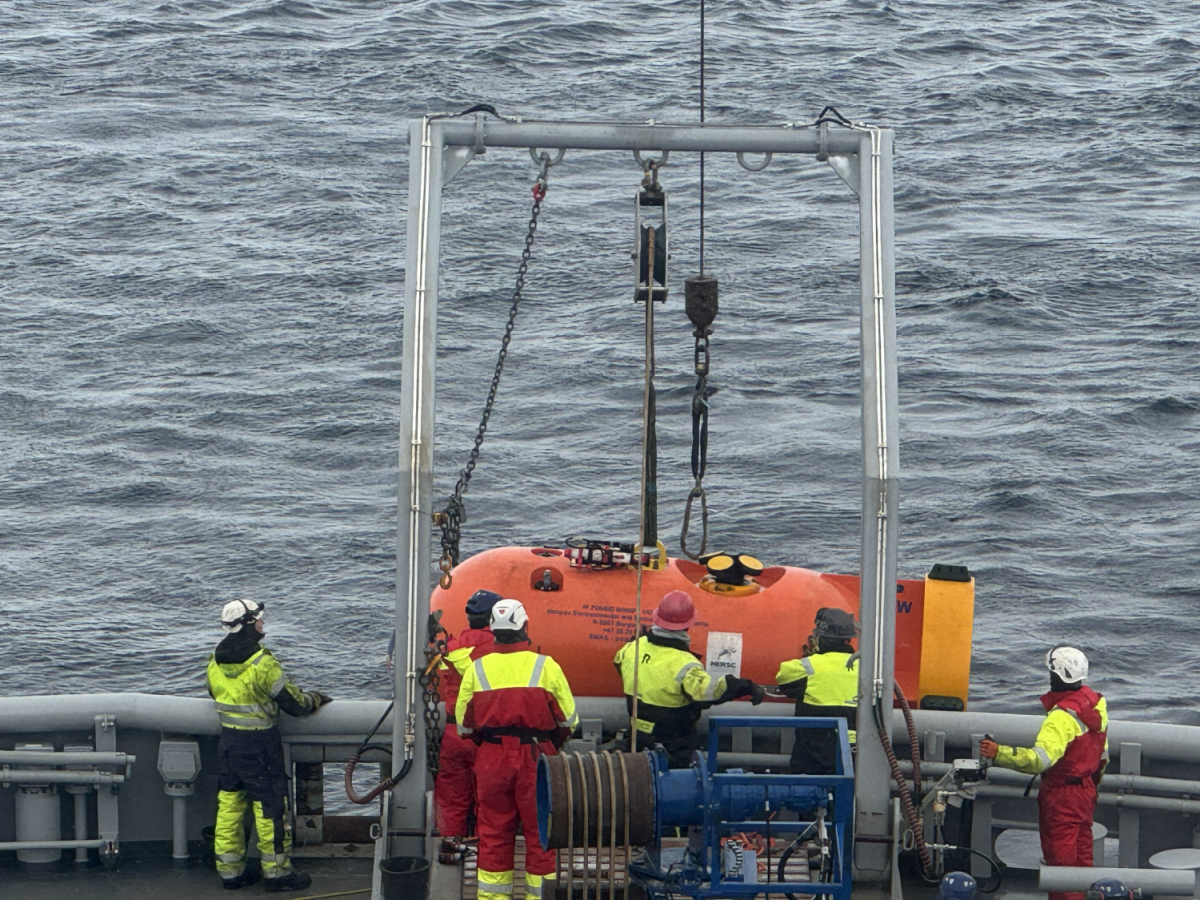
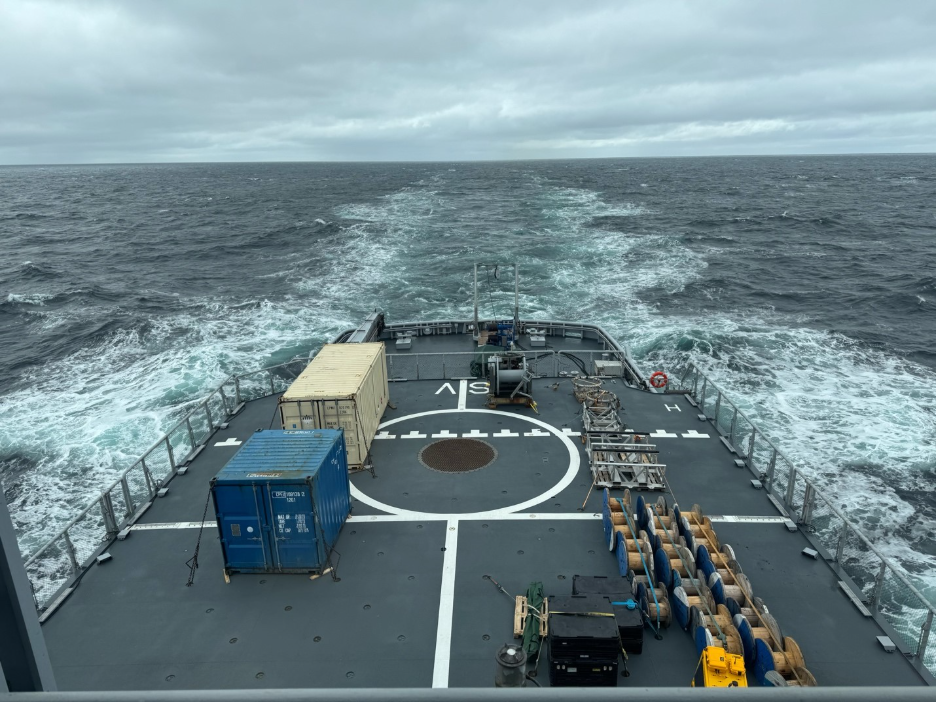
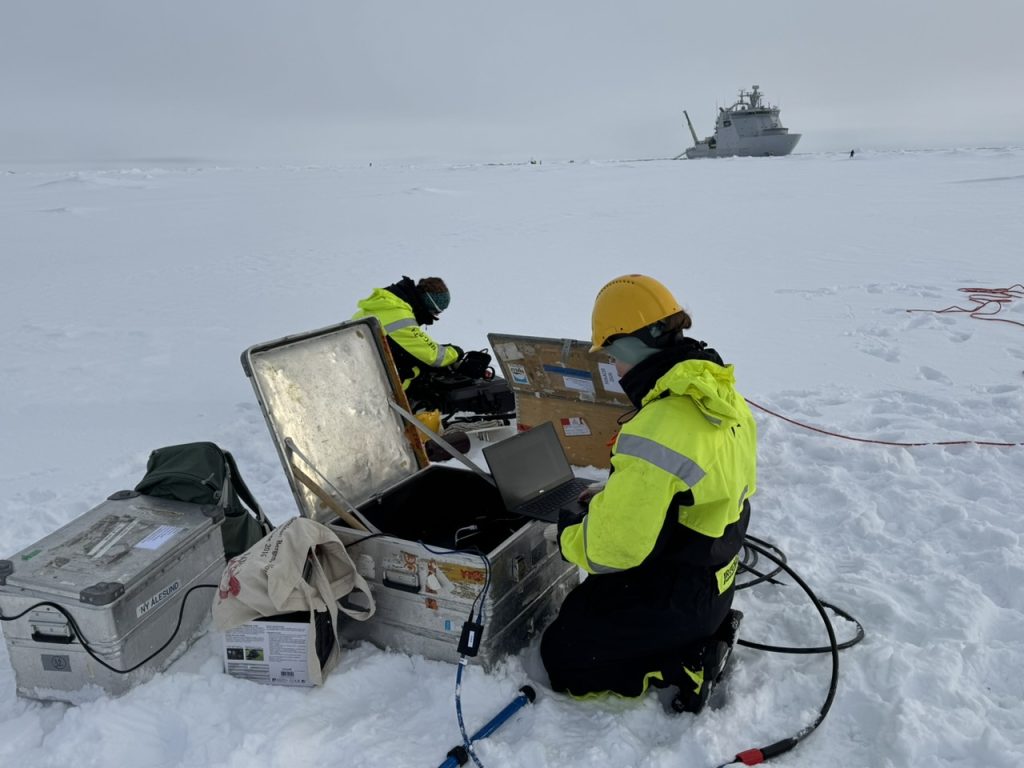
The science team and crew aboard the Norwegian Coast Guard Vessel (NoCGV) Svalbard have successfully recovered network of moorings from the deep and ice-covered Nansen and Amundsen Basins of the Arctic Ocean. The moorings are part of the EU funded project High Arctic Ocean Observation System – HiAOOS and High Arctic Acoustic Thermometry and Soundscape Experiment (HiAATS) funded by Office of Naval Research.
The recovery of these five multipurpose moorings marks the completion of a major observational effort in the ice-covered Arctic Ocean led by the Nansen Environmental and Remote Sensing Center and the Scripps Institution of Oceanography. The moorings have operated beneath the sea ice for two years, collecting valuable data from the deep, ice-covered Nansen and Amundsen Basins North of Svalbard. Two other moorings belonging to the Alfred Wegener Institute (AWI) and Institute of Oceanology Polish Academy of Sciences (IOPAS) were also recovered.
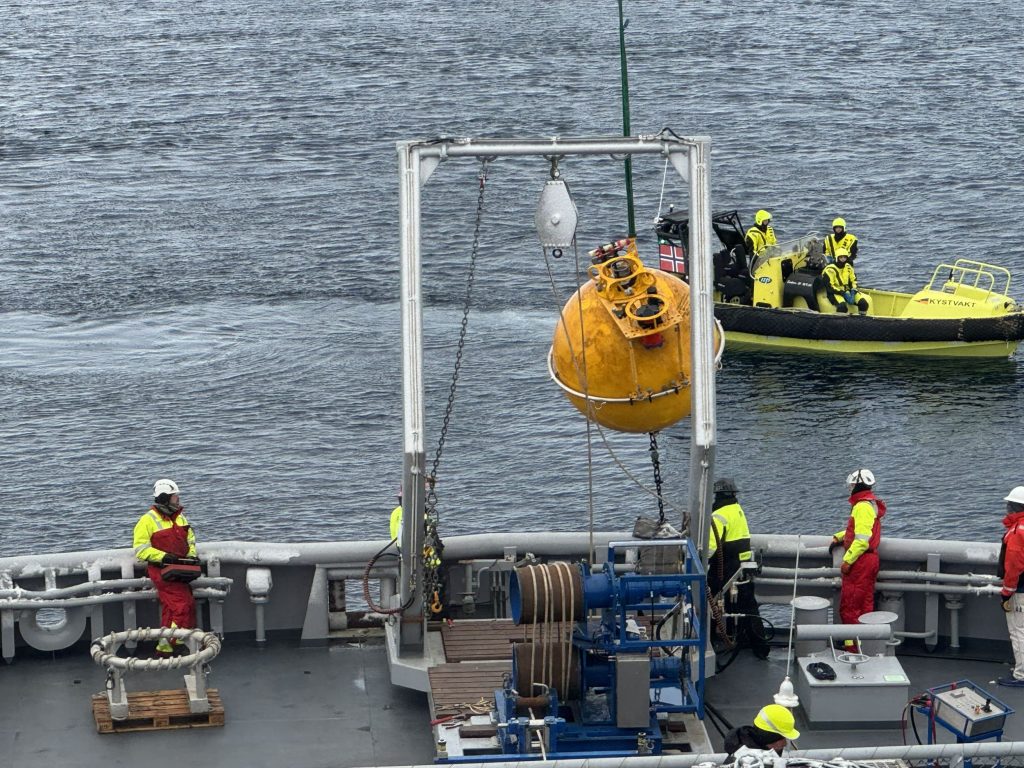
An oceanographic mooring consists of instruments mounted along a wire extending up to 4,000 meters, anchored to the seafloor. Buoyancy elements distributed along the wire keep it taut and vertical throughout the water column, enabling instruments to collect measurements at multiple depths year-round.
Together, this network of moorings forms one of the most extensive observing systems ever deployed in the ice-covered European Arctic Ocean. The system provides a unique dataset on ocean conditions, sea ice, underwater acoustics, and environmental variability in one of the least-observed regions on Earth.

A Unique Arctic Ocean Observing Network
Five of the HiAOOS moorings form a unique acoustic observing network spanning distances of 500 to 1,100 kilometers across the Arctic Ocean. Acoustic signals transmitted between the moorings allow scientists to measure variations in the speed of sound in seawater along 12 sections once every 48 hours. The sound speed measurements along the longest section (1100 km) are done in 12.5 minutes. These synoptic measurements can be converted into estimates of average ocean temperature over vast areas of the Nansen and Amundsen Basins.
This method, known as acoustic thermometry, provides a unique view of how ocean temperature varies across space and changes over time. Unlike traditional oceanographic measurements, which represent conditions at a single location, acoustic thermometry yields an average temperature over hundreds of kilometers. This offers valuable insight into large-scale ocean variability and change.
The acoustic thermometry measurements are complemented by more than 150 temperature sensors distributed throughout the mooring array. The moorings also carry instruments that measure salinity, ocean currents, sea-ice conditions, and underwater sound from marine mammals, vessel traffic, and seismic activity. Together, these observations constitute one of the most comprehensive datasets ever collected from the ice-covered Eastern Arctic Ocean.
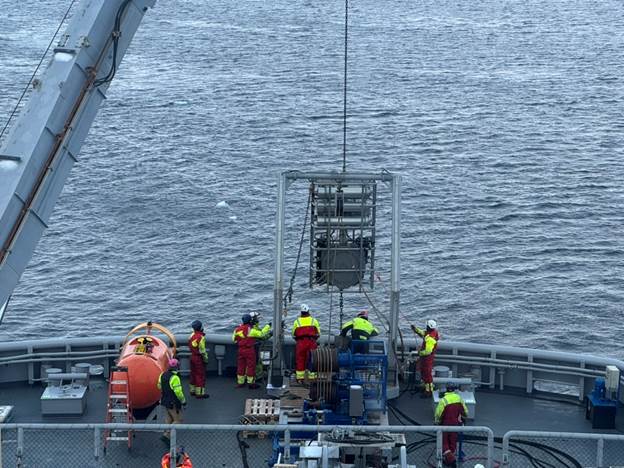
The data provide new insight into how the ocean beneath the sea ice varies in both time and space and will contribute to a better understanding of the processes driving change in the Arctic Ocean. The observations also provide an important basis for evaluating and improving ocean models, while documenting long-term changes in one of the world’s least-observed marine environments.
At the same time, the network demonstrates how acoustic signals can be used for precise positioning and navigation beneath sea ice. This technology could enable the expansion of the Argo Programme into ice-covered regions through tracking of profiling floats and support navigation of autonomous underwater vehicles in areas where GPS signals are unavailable. These capabilities open new opportunities for future observing and research operations in the Arctic Ocean.
The successful recovery of all five HiAOOS moorings further demonstrates that continuous long-term observations can be sustained in the challenging environment beneath Arctic sea ice. This represents an important step toward establishing long-term observing systems capable of monitoring environmental change in ice-covered seas. Collaboration with the Norwegian Coast Guard has been essential for the deployment, operation, and recovery of the moorings.
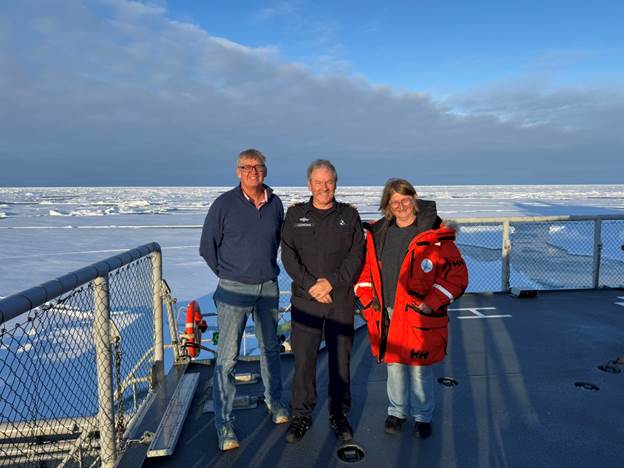
“These observations are valuable not only because they help improve ocean models, but because they provide a direct measure of the present-day state of the Arctic Ocean beneath the sea ice. The observations tell us how the ocean actually is today. To determine whether the changes we observe are part of long-term climate trends or natural variability, we need continuous measurement records spanning many years. Long-term monitoring beneath the sea ice is essential for understanding and predicting the future evolution of the Arctic Ocean and its role in the global climate system.” Hanne Sagen, HiAOOS Project Coordinator, Nansen Environmental and Remote Sensing Center.
“Acoustics is proving to be valuable complementary data to other traditional measurements that are difficult to obtain in the ice-covered seas. We are very happy that our measurements were successful. The two year record provides large scale averages over hundreds of kilometers every two days that are unavailable by any other means.” Matthew Dzieciuch, HiAATS Project Coordinator, Scripps Institution of Oceanography.
“These operations and our collaboration with the research community provide the Coast Guard with valuable experience and training in icebreaking, ice navigation, and the execution of complex maritime operations under demanding Arctic conditions. This expertise is essential for maintaining Norway’s search-and-rescue capabilities in waters extending all the way to the North Pole. A Norwegian presence in the Arctic Ocean is becoming increasingly important as activity in the region grows. Research and observing activities contribute not only to scientific knowledge, but also to operational experience and a continuous Norwegian presence in an area of increasing international importance.” Geir-Martin Leinebø, Commanding Officer, NoCGV Svalbard.
Collaboration and Support
The HiAOOS observing system is the result of a long-term collaboration between the Nansen Environmental and Remote Sensing Center (NERSC), Scripps Institution of Oceanography (SIO), and Woods Hole Oceanographic Institution (WHOI), building on decades of joint development of acoustic observing systems for the Arctic Ocean.
The recovered moorings are equipped with instruments and technologies provided by NERSC, SIO, WHOI, the Naval Postgraduate School (NPS), the Norwegian Polar Institute (NPI), the University of Bergen (UiB), and the Institute of Oceanology of the Polish Academy of Sciences (IOPAN).
The HiAOOS project is funded by the European Union Horizon Europe Programme (Grant Agreement No. 101094621) and the Office of Naval Research (ONR). Ship time aboard KV Svalbard has been provided by the Norwegian Coast Guard with support from the Research Council of Norway.
The successful recovery of the moorings is the result of the outstanding efforts of Captains Einar Overaa and Geir-Martin Leinebø, the crew and conscripts aboard KV Svalbard, together with a broad international scientific partnership. This collaboration has made it possible to conduct long-term observations in one of the world’s most remote and operationally challenging marine environments.
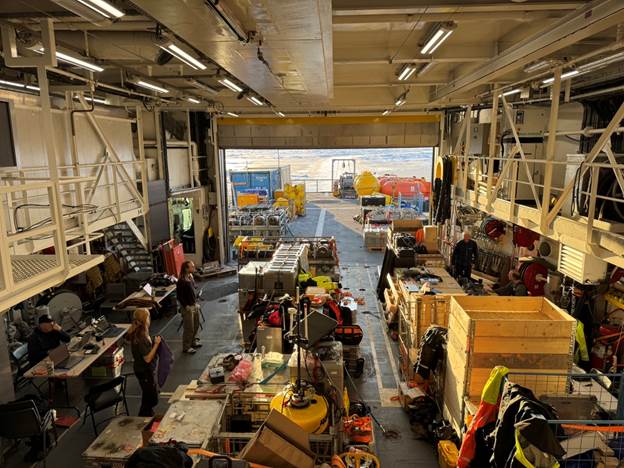
* Cover image: Recovery of the major floatation buoy used to keep the mooring standing vertical in the water during the experiment. (Photo credit: Hanne Sagen, Nansen Environmental and Remote Sensing Center).
Check out other news from HiAOOS Arctic adventures in 2026: